
SAGE MOUNTAIN 945 East Paces Ferry Rd NE, Suite 2660, Atlanta, GA 30326
Sage Mountain Research
Q2 2026 Market Update
Q2 recap and Q3 outlook…
Stocks staged a strong recovery in Q2, with the S&P 500 gaining +15% and finishing near record highs. The Middle East conflict and oil shock that started in Q1 continued for most of Q2, but oil prices fell as the two sides worked toward a ceasefire agreement. Meanwhile, investors’ enthusiasm for artificial intelligence stocks returned, fueling a rally in semiconductor stocks. As companies reported strong Q1 earnings, the gains broadened beyond technology to include mid-and small-cap stocks. Even as stocks rallied, market conditions continued to evolve. The spring rise in oil prices lifted inflation to a three-year high, and the Federal Reserve signaled a potential shift from rate cuts to rate hikes.
The energy shock that started in Q1 unwound almost as fast as it arrived. Oil peaked near $115 in early April as the Middle East conflict closed the Strait of Hormuz, disrupting global oil supply. Energy prices remained volatile throughout the quarter, but oil ended Q2 near $70, returning to where it traded when the conflict began. The decline followed a ceasefire between the U.S. and Iran and expectations for the Strait, which carries nearly 20% of the world’s oil, to reopen. Gas prices followed the same path, rising sharply during the spring before falling in late Q2.
The price reversal matters because energy prices feed directly into inflation, which in turn shapes the outlook for interest rates. When oil spiked earlier this year, inflation followed. Consumer prices rose +4.2% year-over-year in May, the highest in three years, with over half of the monthly increase tied to energy. The oil price spike and the subsequent rise in inflation reshaped the interest rate outlook.
Coming into this year, the market expected the Federal Reserve to cut interest rates two or three times. During Q2, the market swung from expecting rate cuts to pricing in a rate hike this fall. The Federal Reserve held interest rates steady at both of its meetings during Q2, but it leaned toward the market’s view, signaling that its next move could be up rather than down. With oil back at pre-conflict levels, the main driver of higher inflation has started to fade, and inflation is expected to ease in the months ahead. What stands out for the full quarter is how the market handled the episode. There were stretches of volatility as the conflict dominated headlines in the spring, but stocks moved past them and finished Q2 higher.
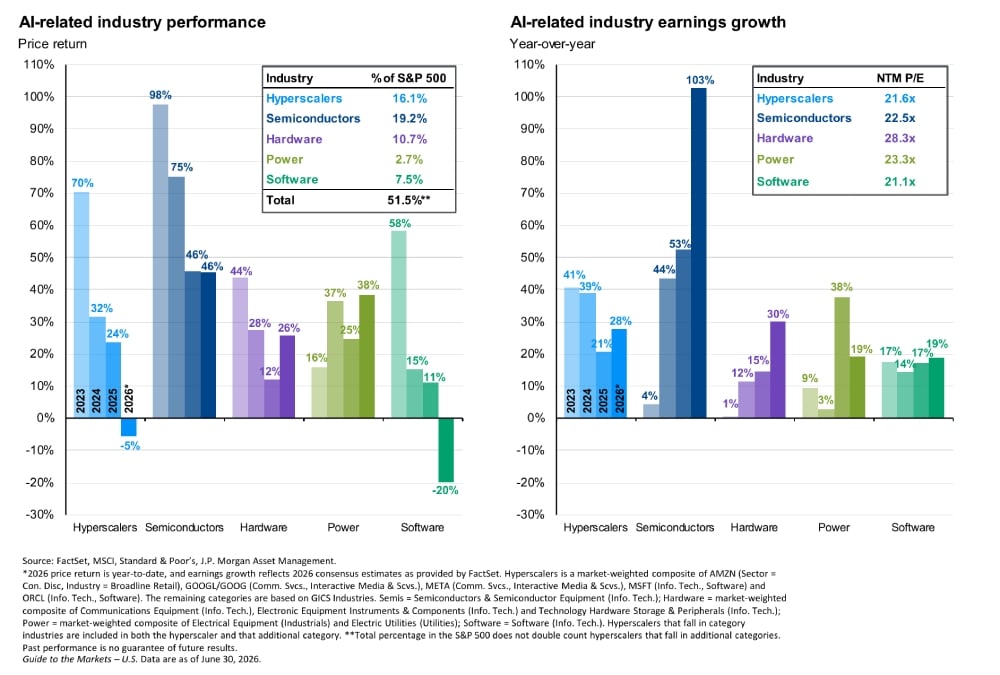
Semiconductor stocks led the market’s advance, posting their strongest quarter in nearly 30 years. The group returned +88% for the quarter and was up nearly +100% before pulling back in the final weeks of June. The only comparable quarters occurred in the late 1990s, when the internet went mainstream.
The rally is anchored to a wave of technology investment, with much of the money flowing to the chipmakers. The largest tech companies building AI infrastructure—Microsoft, Amazon, Meta, Alphabet, and Oracle—spent a combined $32 billion in 2016. By 2025, that figure had grown to roughly $416 billion. The pace continues to climb: the five companies are projected to spend about $724 billion this year and nearly $900 billion next year. The capital expenditures pay for data centers, the computer chips inside them, and the equipment and power to run it all. The companies leading the buildout are reporting record earnings and growing backlogs, and many say they’re limited more by how fast they can build than by demand.
The surge in spending is also reshaping financial markets. Private companies are going public to fund their spending, while public companies are turning to debt and equity markets to finance their buildout. SpaceX completed the largest IPO in history during Q2, raising $85 billion. Other well-known private companies, including OpenAI and Anthropic, are expected to follow over the next year. In the public market, companies such as Alphabet and Oracle are issuing both stock and bonds to fund their spending. The amount of money being raised, and the spending plans behind it, point to a buildout that is still expanding.
A move of this size, both the spending and the share price gains, is historic. The market is treating AI as a major technological shift, and the quarter brought increased spending and earnings growth, with companies signaling more spending ahead. At the same time, a quarter like this shows how much future growth is already priced in. The closest historical parallel, the late 1990s, points to what rapid transformation tends to bring: both real opportunity and high expectations.
Beneath the headline rally in tech, Q2’s gains were broad. The S&P 500 has gained +10.2% this year, but strip out the tech sector and that falls to +5.1%, an indication of how much of the index’s return has come from a single sector. The S&P 400, an index of mid-cap stocks, and international stocks have both returned approximately +17%, while the small-cap Russell 2000 has gained +22%. For most of the past few years, the stock market’s gains were concentrated in a handful of mega-cap tech stocks. Market leadership has broadened this year, creating a more balanced market.
Several developments explain why the rest of the market has started to outperform. The first is profitability. Smaller companies’ profit margins weakened in 2022 and 2023 as inflation spiked and the Federal Reserve raised interest rates. Small caps tend to carry more floating-rate debt, so as the Fed cut rates in recent years, the interest savings flowed to their bottom line. The second is the economy. Smaller companies are more sensitive to domestic economic conditions, so the economy’s resilience has been a direct tailwind. There were concerns that this year’s oil shock would weigh on the global economy like past oil crises. However, today’s economy depends far less on energy than it did in the 1970s, and the impact has so far been relatively contained. The third is valuation. After years of tech stocks leading the market, smaller companies look cheaper by comparison, and their improving earnings have made that gap harder to overlook.
No single factor explains the shift, but together they make a fundamental case for why the gap has started to close. Profit margins are improving, the economy continues to expand, and parts of the market trade at valuation discounts. As this year has shown, holding a mix of company sizes, styles, and geographies means not depending entirely on any single part of the market to do well.
Equity markets traded higher throughout the second quarter, with most of the advance coming in April as stocks rebounded from lateMarch lows. The strength carried into May, with the S&P 500 posting a nine-week winning streak into month-end. The index set a record high in early June before giving back some ground to finish up +15.2%, its strongest quarter since Q2 2020. The Nasdaq gained +27.7% as tech stocks led the market rally. As mentioned in the prior section, market breadth remained strong during the quarter. Smaller companies outperformed most major indexes in Q2, with the Russell 2000 gaining +21.5%.
From a sector perspective, nine of the eleven S&P 500 sectors finished higher. However, technology was the only sector to outperform the broad index, with a gain of +31.8%. Of the remaining sectors, Industrials, Consumer Discretionary, and Financials each rose +9% or more, while defensive sectors such as Utilities and Consumer Staples were flat. Energy was the only sector to trade lower, falling -13.4% as oil prices returned to pre-conflict levels.
International markets advanced alongside U.S. stocks, with the same divide between tech stocks and the rest of the market showing up overseas.
Emerging markets gained nearly +24.1%, as Asian markets like South Korea and Taiwan benefited from the same semiconductor rally as in the U.S. Developed markets gained +11.1% but trailed both emerging and U.S. stocks due to their lighter tech exposure.
The bond market had another volatile quarter as interest rates tracked the path of oil. Treasury yields rose early during the quarter as oil prices remained elevated and the odds of a rate cut weakened, then reversed lower in June as energy prices declined and the inflation outlook improved. The 30-year Treasury was especially volatile, rising to its highest level since 2007 over concerns about oil, inflation, and a Fed leaning toward higher rates. Shorter-term yields, which are the most sensitive to Federal Reserve policy, also increased over the quarter as the market priced out additional rate cuts and began to weigh the possibility of a rate hike. By the end of the quarter, the volatility had eased and yields stabilized. The Bond Aggregate, a broad index of U.S. investment-grade bonds, returned +0.7% for the full quarter.
Corporate bonds outperformed during Q2, with high-yield gaining +2.4% and investment-grade returning +1.8%. Credit spreads, which measure the difference in yield between corporate and government bonds, retightened after widening in the spring as oil prices rose. Overall, credit spreads remain tight by historical standards, signaling continued confidence rather than concern.
Despite the positive performance overall, uncertainty remains regarding: the path of oil and inflation, the durability of the AI investment cycle, and whether the market’s broadening outside of technology continues. The remainder of this year will be shaped by how each plays out. The first is the path of inflation and interest rates. With oil back near where it started, inflation is widely expected to ease. However, the recent tensions during the ceasefire and MOU are still creating doubts. If tensions rise dramatically it could create a replay of the first quarter. In the meantime, the next few inflation reports will go a long way toward answering what the Fed does next.
The second and larger question is the AI buildout. The spending behind it has been enormous, and the gains in the stock market have been commensurate. The question now is whether both can hold. The AI trade has become popular, and the late-quarter pullback in technology showed how quickly stock prices can swing when expectations are high.
Over time, the spending will need to translate into real profits to justify the scale, especially as a growing share of it is funded by issuing new debt and stock. The past quarter showed the promise of the technology while serving as a reminder of how much is already expected of it.
The third is whether the market’s broadening continues. This year has been unique, with broad participation across the market existing alongside narrow leadership at the very top. Most sectors and company sizes have participated in the stock market rally, even as a small group of technology stocks has driven the largest share of the returns. The question is whether the gains keep spreading or leadership narrows again to a handful of names.
A list of open questions can naturally create some unease, so it’s worth looking at how the past quarter unfolded. The market faced a war, an energy shock, inflation at a three-year high, and a Federal Reserve signaling a potential rate hike. Through all of it, stocks not only held their ground but traded to new highs. We can’t know exactly how the questions will resolve, but a diversified portfolio and a long-term perspective can help navigate periods of uncertainty.
Index Returns
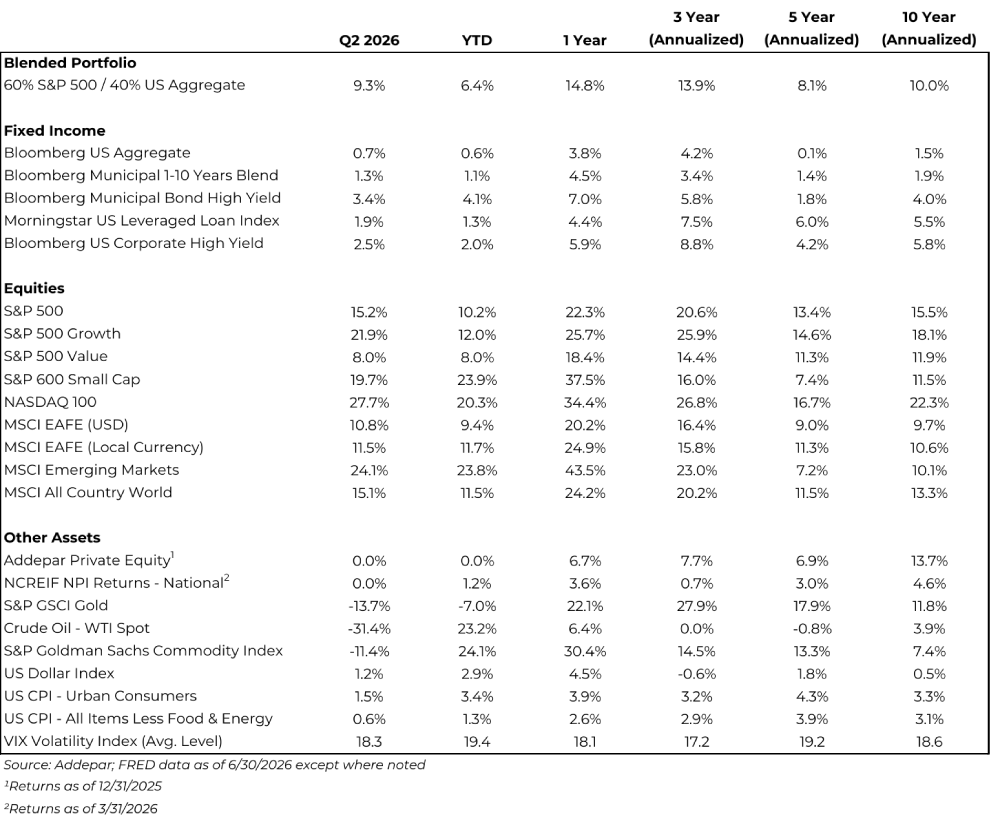
Bonds were volatile in the first half but ended with modest gains. We expect rates to stay range-bound through the second half, as the Fed has reason to wait for inflation to normalize before acting. As liquidity conditions remain good and the economy rolls along, spreads are unlikely to widen near-term.
For U.S. stocks, the bull case rests on continued earnings strength, which has been playing out, but likely depends on continued AI investment momentum. Financing and supply chain constraints could represent risks to the thesis. We are mindful that higher AI venture company valuations and strong capex orders translating into faster revenue growth relative to depreciation have boosted earnings.
International stocks remain attractive, primarily due to valuation, but, as in the U.S., demand for AI pick-and-shovel plays may have driven prices up too quickly.
In private markets, institutions have stood by private credit even while retail seeks to exit. Fundamentally, the ability to repay looks strong. Private equity continues to have some trouble exiting without a more open IPO market, a dynamic we expect to drag on.
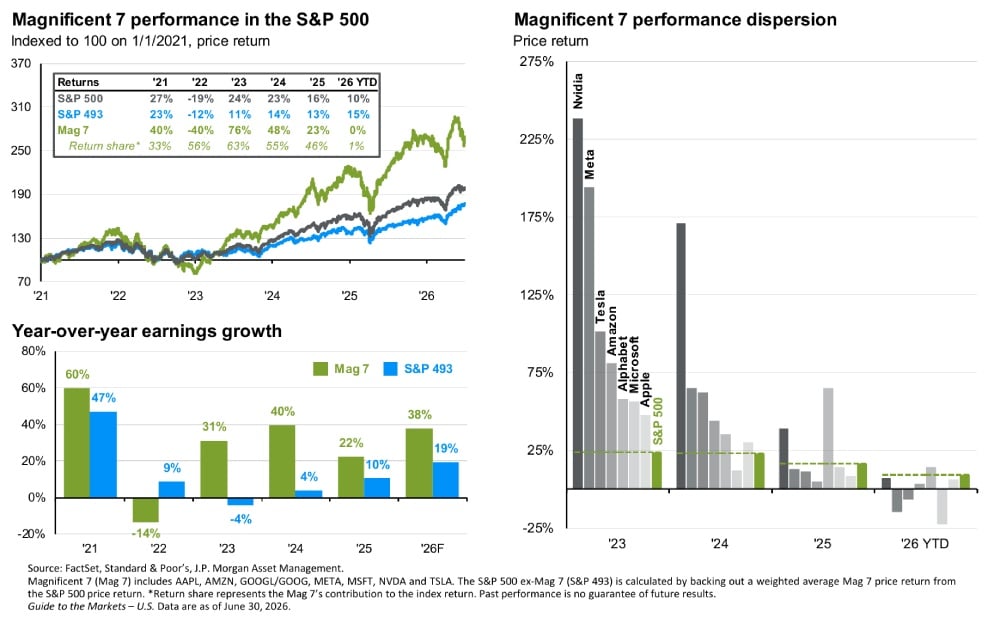
3Q 2026 Equities Outlook – Returns Broadened Beyond the Mag 7
After contributing a large portion of the S&P 500’s gains over the past few years, the Magnificent 7 stocks were flat in the first half while the broader market rallied.
3Q 2026 Equities Outlook – Strong Continued Growth
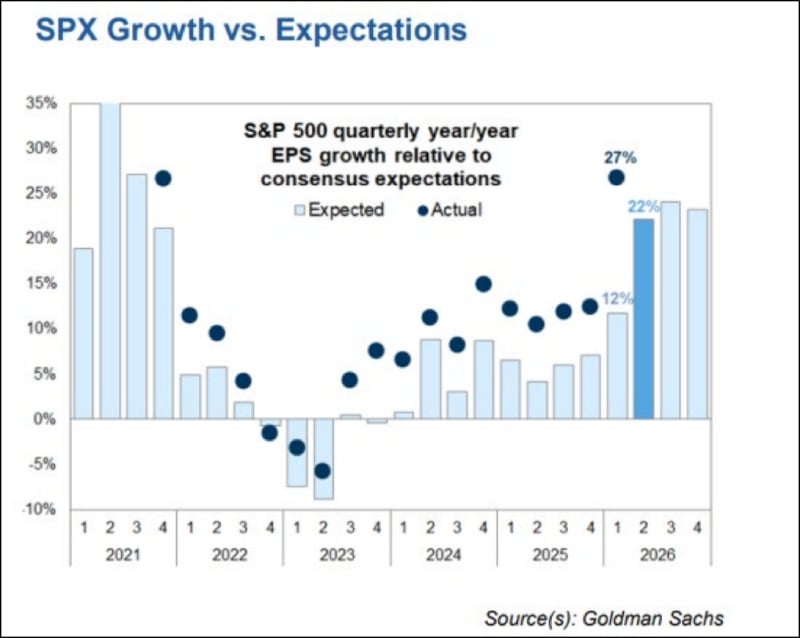
Q2 earnings season will kick off later this month, with consensus forecasts for 22% growth year-on-year. Goldman Sachs reports that AI infrastructure stocks are expected to contribute nearly 60% of S&P 500 EPS growth this quarter, with Micron and NVIDIA together accounting for more than 40%.
3Q 2026 Equities Outlook – Margins Remain High
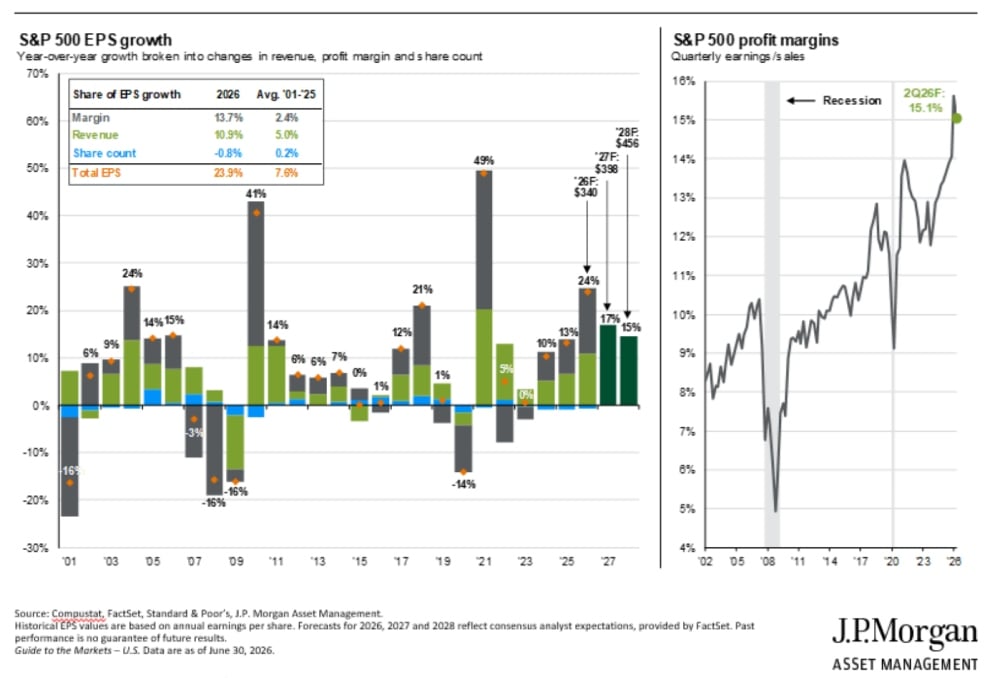
Very strong profit margins continue to drive S&P earnings higher. Margins were an even more important than revenue growth in the recent earnings acceleration.
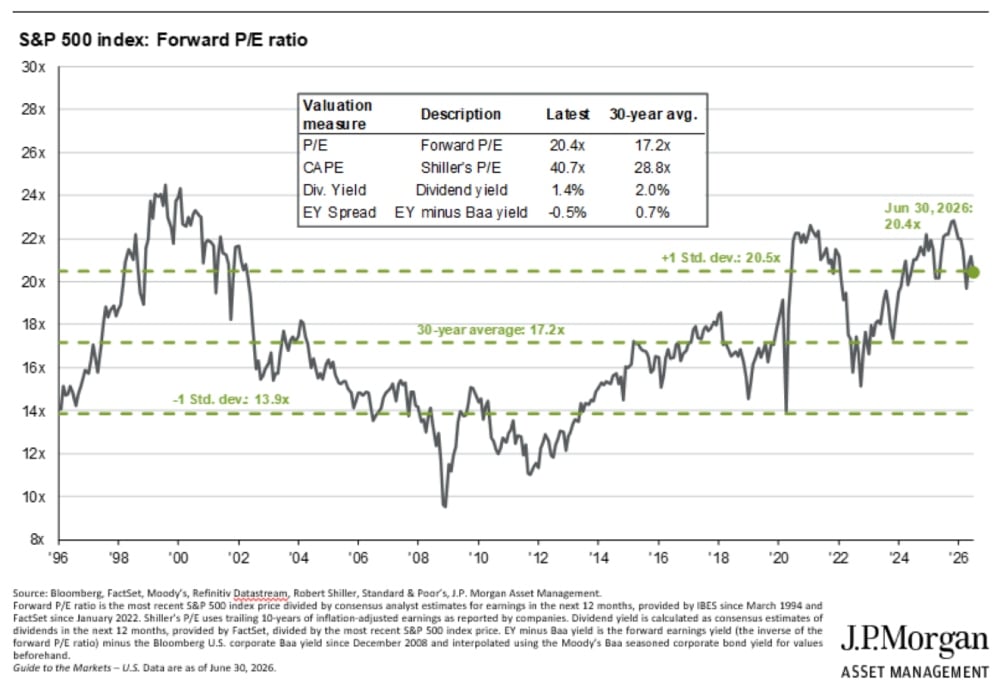
3Q 2026 Equities Outlook – Valuations Are High, But Below
Recent Peaks
3Q 2026 Fixed Income Outlook – Shifts in the Outlook
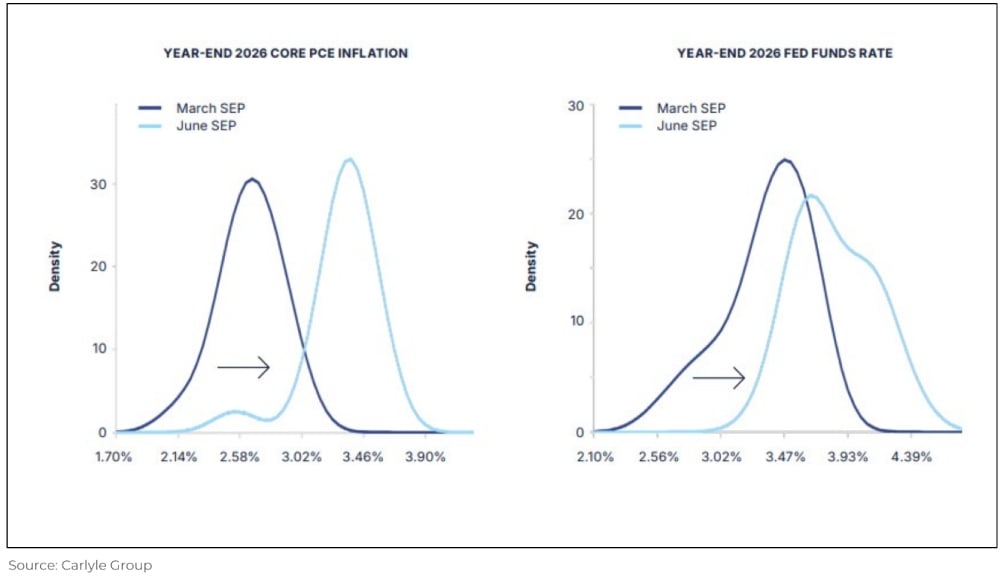
The Fed Funds rate is expected to remain higher as inflation forecasts have increased.
3Q 2026 Fixed Income Outlook – A New Era of Higher Yields?
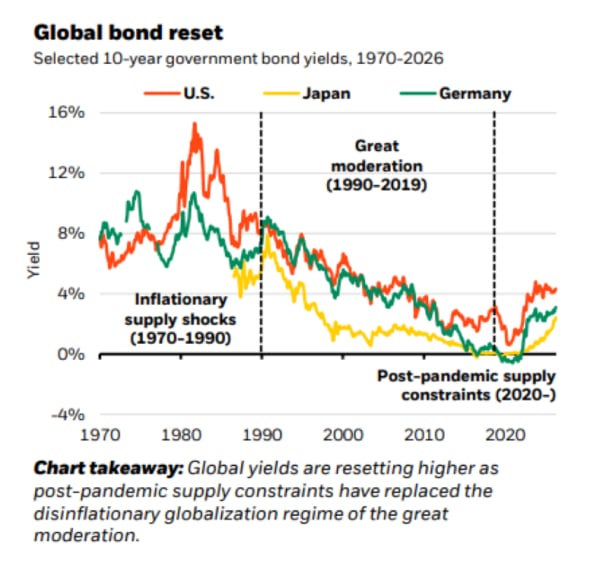
Looking at the longer-term perspective, we may be in a global era of higher interest rates.
Fixed Income – Tight Spreads, Low Defaults
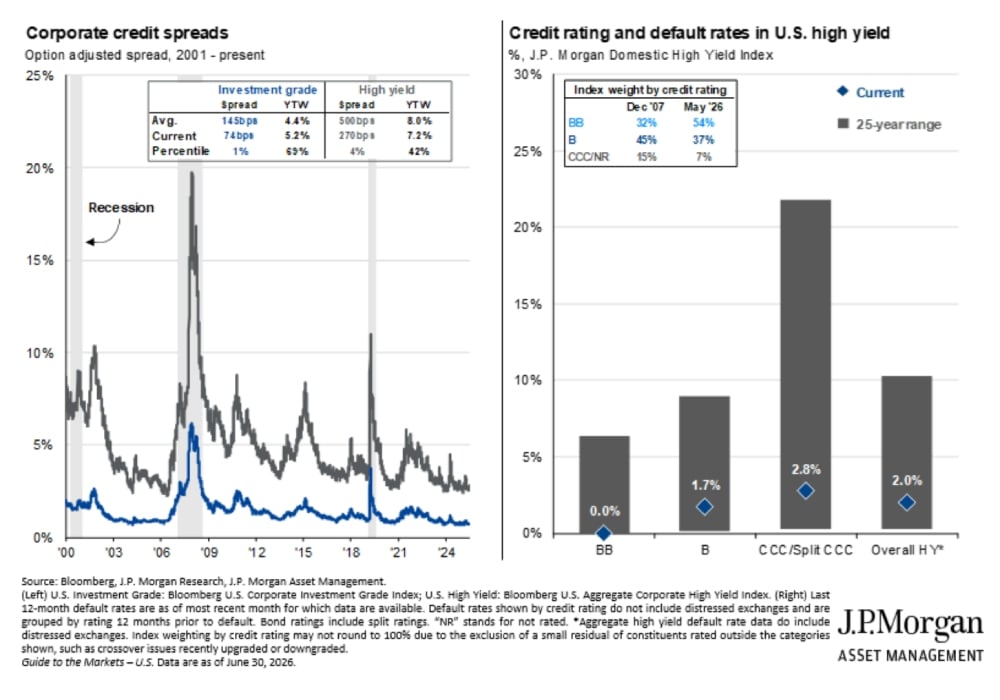
Credit spreads remain historically tight, and credit agencies’ assessment of corporate creditworthiness continues to rise.
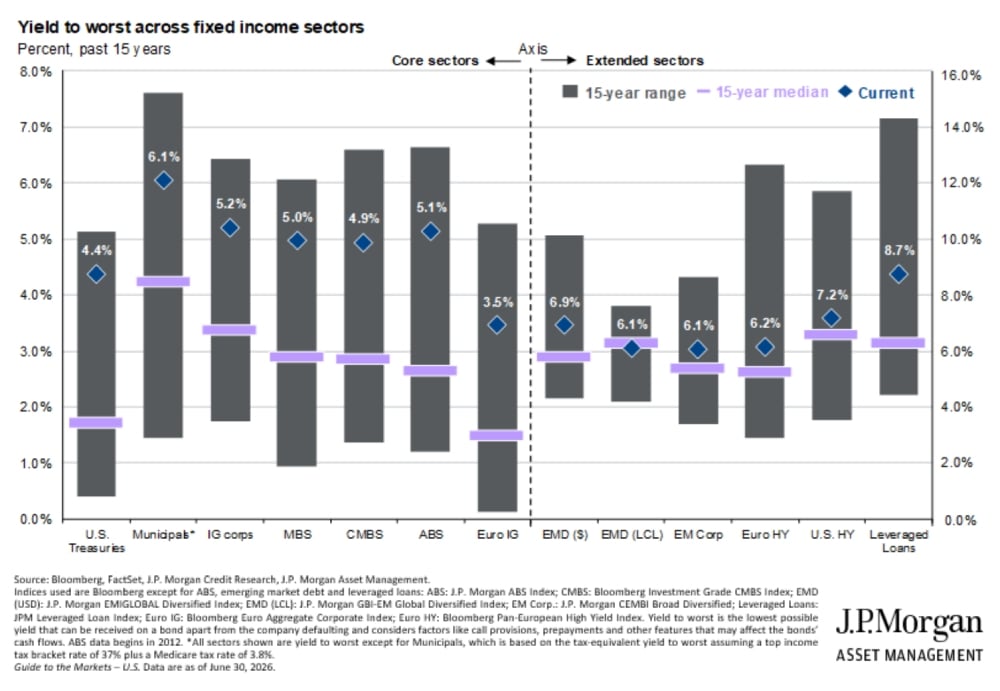
Current Yields Across Credit Asset Types
New Fed Chairman
- Kevin Warsh was sworn in as the 17th Fed chairman on May 22, 2026, succeeding Jerome Powell, after the narrowest confirmation vote in U.S. history (54-45).
- Despite Trump’s clear preference for faster rate cuts, Warsh told the Senate he intends to be “strictly independent” and has pushed back on calls for immediate easing. At the most recent FOMC meeting, his tone leaned hawkish: he stated that inflation has been running well ahead of the Fed’s 2% target for more than five years, and that the committee is unanimous in its commitment to delivering price stability.
- Policy direction to watch: Warsh wants to end forward guidance, meaning the dot plot showing each FOMC member’s projected rate path could disappear under his leadership. Other stated priorities include studying how AI could affect economic output, shrinking the balance sheet, and ruling out a central bank digital currency.
- Net takeaway: expect a more hawkish, less communicative Fed than under Powell, with rate cuts likely pushed out rather than accelerated in the near term, despite political pressure pushing the other direction.
Alternatives Outlook – Private Equity Exits Deferred Again
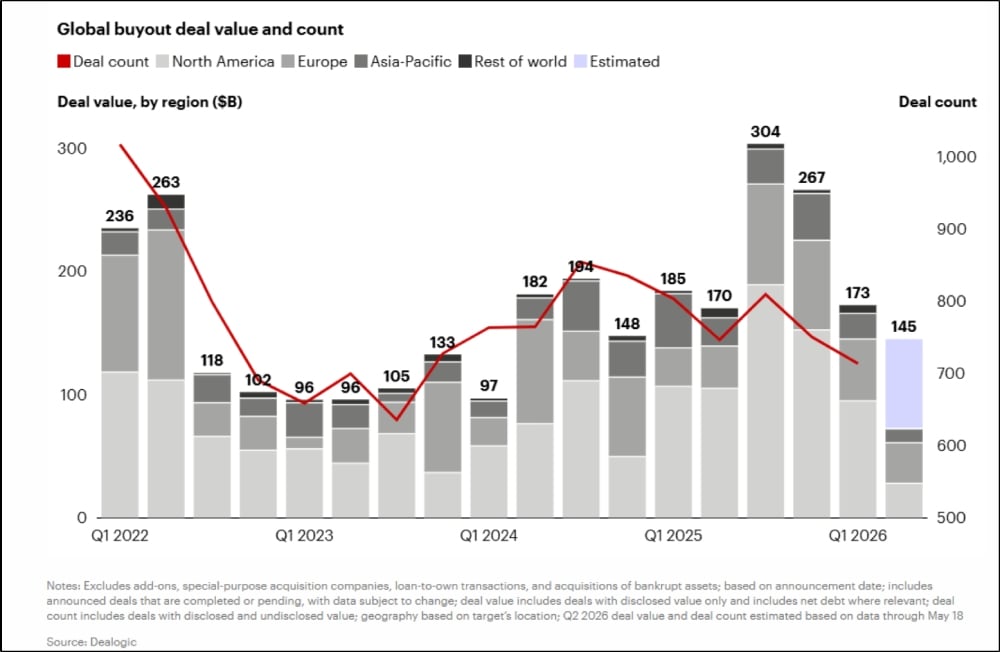
Amid early-year market disruptions, investments, exits, and fundraising all dragged in the first half, and liquidity remained a major challenge.
Alternatives Outlook – Gradual Real Estate Recovery
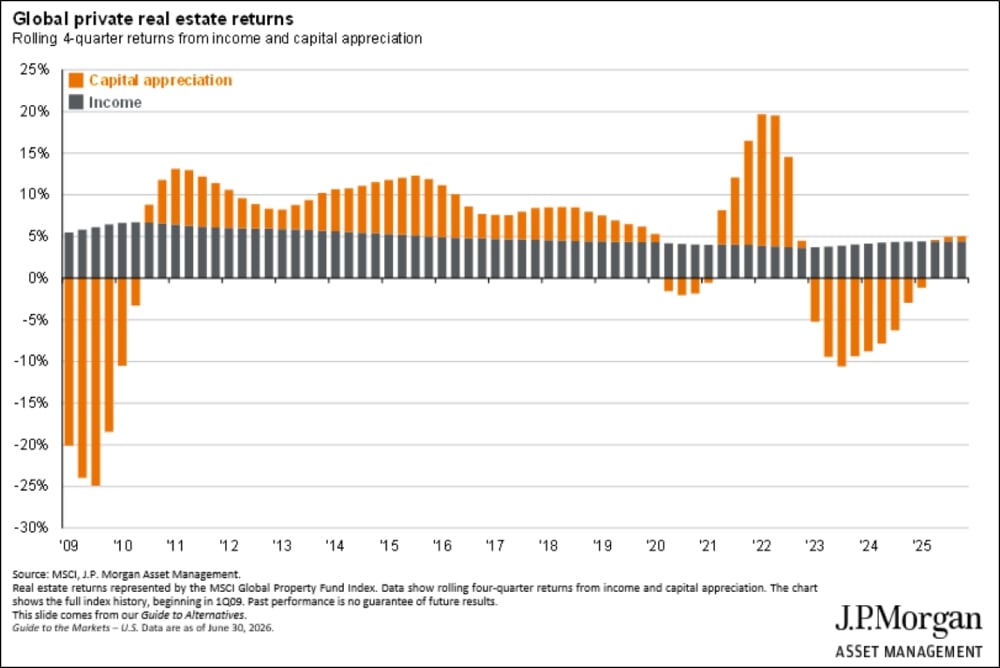
Supply absorption, especially in multifamily, is helping set up commercial real estate for a continued, gradual recovery.
Alternatives Outlook – Private Credit
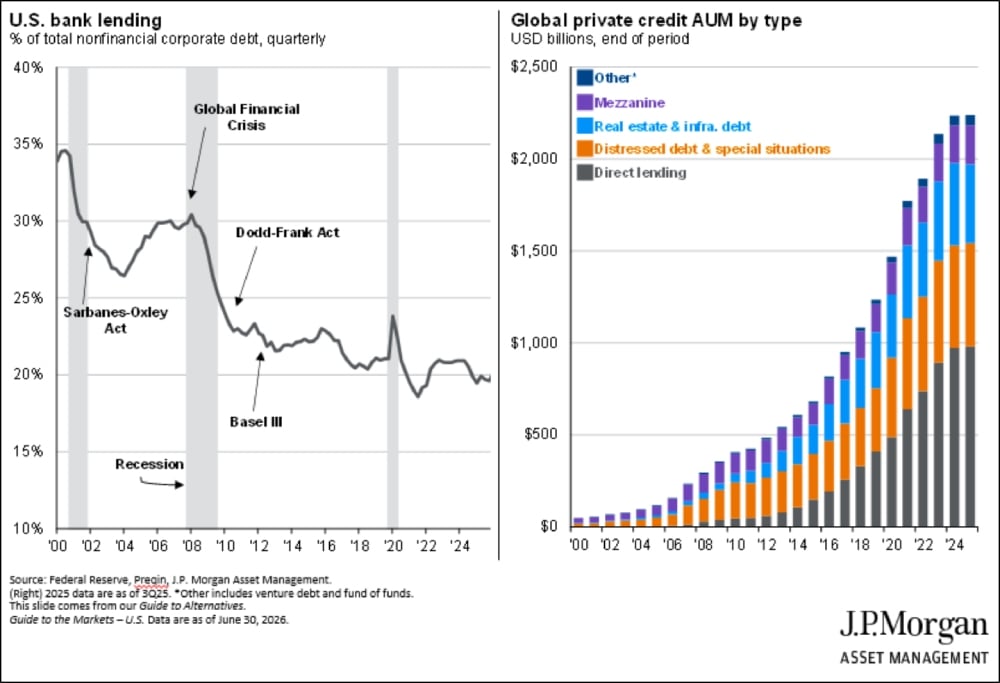
Direct Lending growth has stalled as investors worry about software exposure, but ability to pay seems firm. Banks have not returned to the space.
SpaceX – A Landmark IPO
- SpaceX was the largest IPO on record. The company raised $86 billion, valuing the company at US $1.8 trillion. It closed day one near a $2.1 trillion market cap, the sixth most valuable U.S.-listed company
- Float (shares available) was unusually constrained with only around 5 percent of shares made available to the public. Demand at listing was outsized too, attracting more than $250 billion, over 3x the $75 billion the company was seeking to raise.
- Two opposing forces are in play: early investors and employees gaining the ability to sell as lockups expire over time, against index funds being required to buy as the stock gets phased into benchmarks. These forces are unlikely to balance out cleanly, so continued volatility in the stock is likely.
- Most indexes apply some form of float adjustment, so SpaceX’s initial index weight, and its impact on index performance, will start out modest.
- SpaceX has already been added to most major indexes other than the S&P 500, which will not take place until at least mid-2027.
AI
- AI capex continues to shift from a tech story to a macro one. Data center construction alone is estimated at roughly $2.9 trillion through 2028, with cloud infrastructure spend reaching $670 billion in 2026 and global data center capex exceeding $1 trillion for the year
- Performance is uneven across the technology value chain. Hardware and infrastructure names tied to the buildout, including memory, networking, and power, have posted some of the largest gains this year. Meanwhile, software application stocks have seen their combined market cap decline significantly amid concern that A.I. could disrupt their business models.
- The bubble debate persists. Several academics and economists claim we are in an AI bubble, drawing parallels to the dot-com era. Bulls counter that current valuations are backed by real earnings growth rather than multiple expansion alone, unlike 2000. Time will tell if the technology is as transformative as many now believe.
AI – Impact on Profits
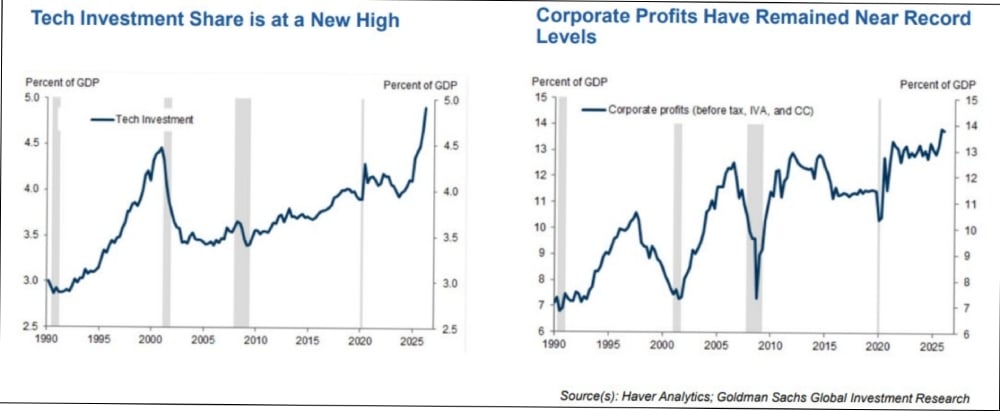
These charts show how accelerating tech investment is boosting aggregate profits.
AI – Investment
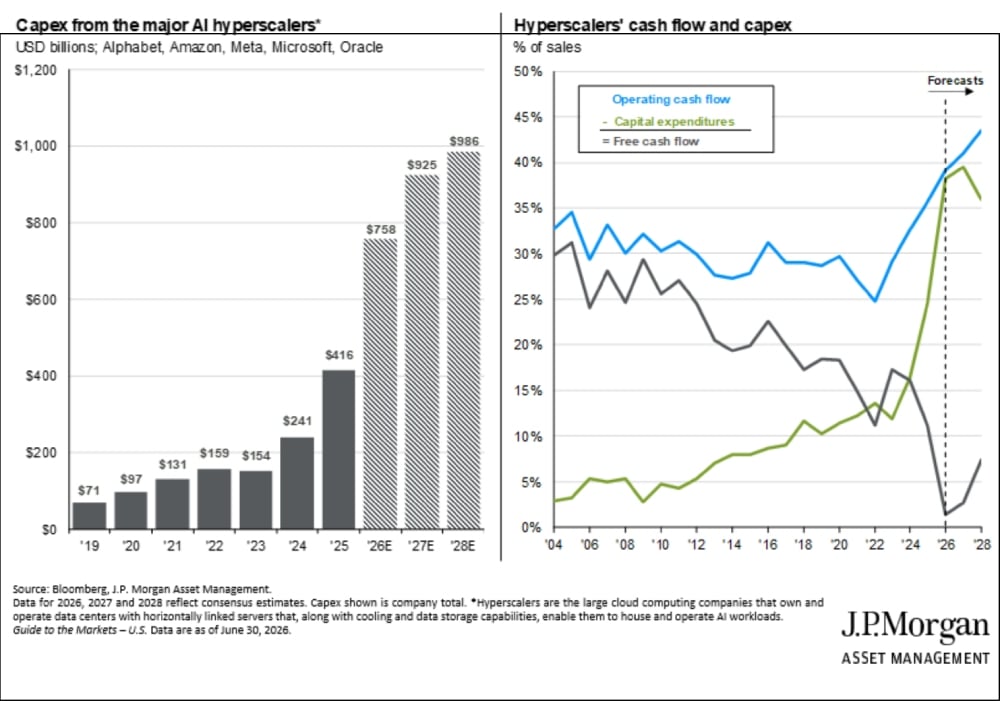
These charts show the sheer scale of A.I. capex investment and how hyperscalers can no longer pay exclusively from cash flow – the key question is whether and when there will be a tangible return on this spending.
AI – Some Concern Around Hyperscaler CapEx
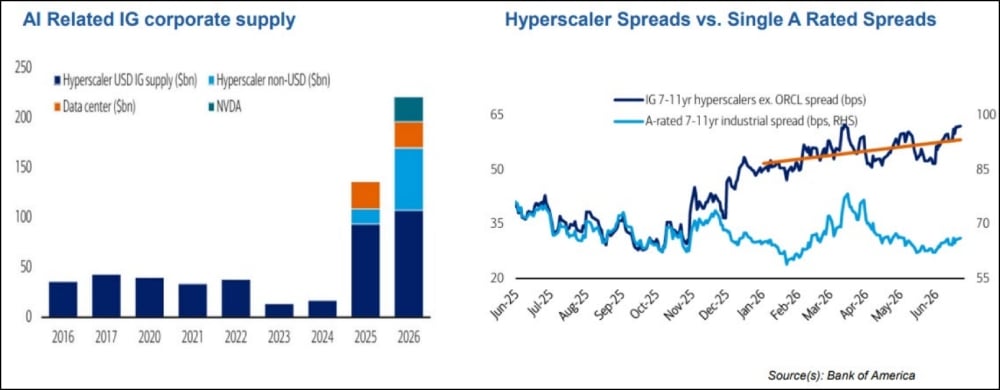
As hyperscalers turn to debt financing, they are paying a widening premium relative to comparably rated firms.
AI – Related Industry Performance
3Q 2026 Economic Outlook
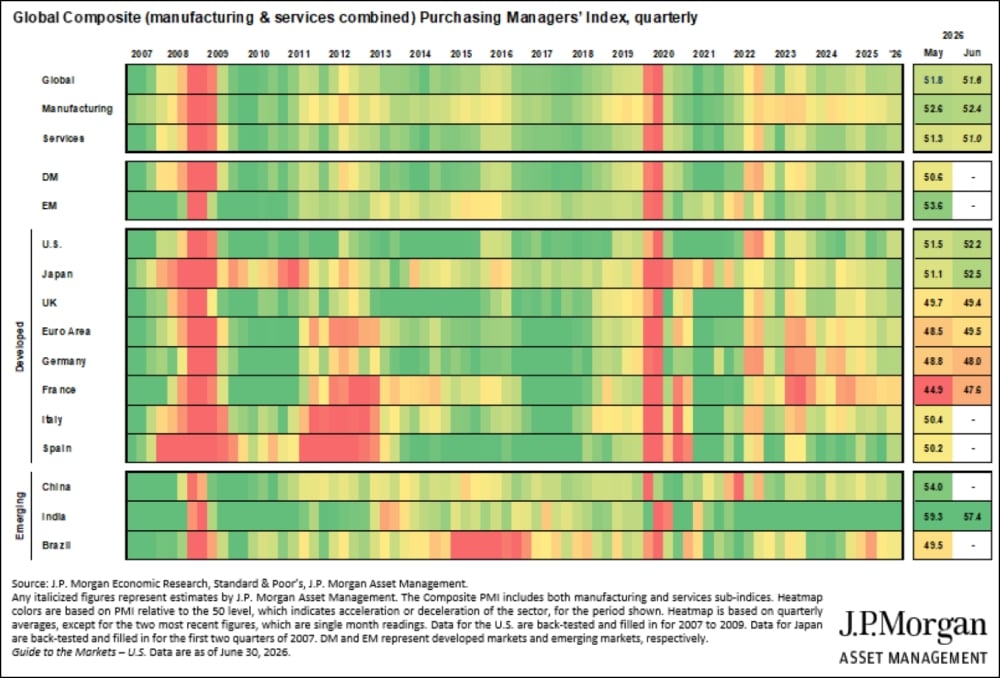
Globally, growth has normalized following the COVID bust then boom, followed by the Russia-Ukraine and tariff disruptions.
3Q 2026 Economic Outlook
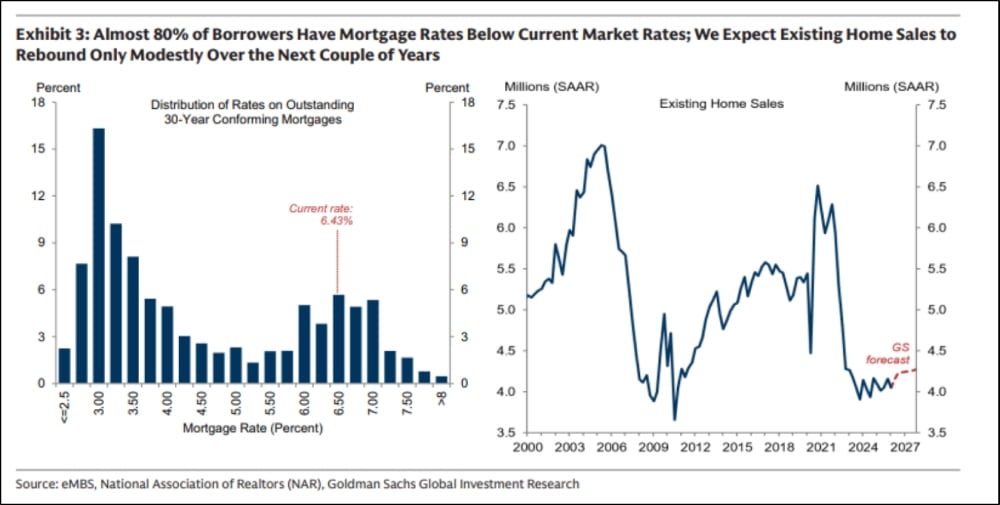
We believe housing transactions will likely remain slow.
3Q 2026 Economic Outlook
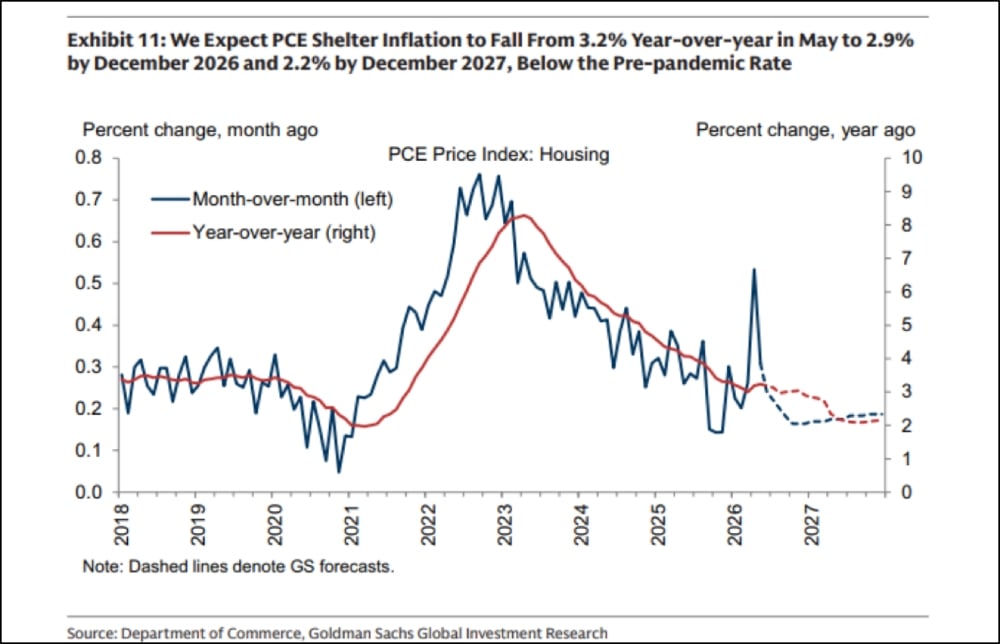
The official measures of shelter inflation capture rents for both new and continuing leases. While new-lease rent growth has been running soft, only a modest share of tenants move each year. Rents should slowly moderate compared to other costs.
3Q 2026 Economic Outlook
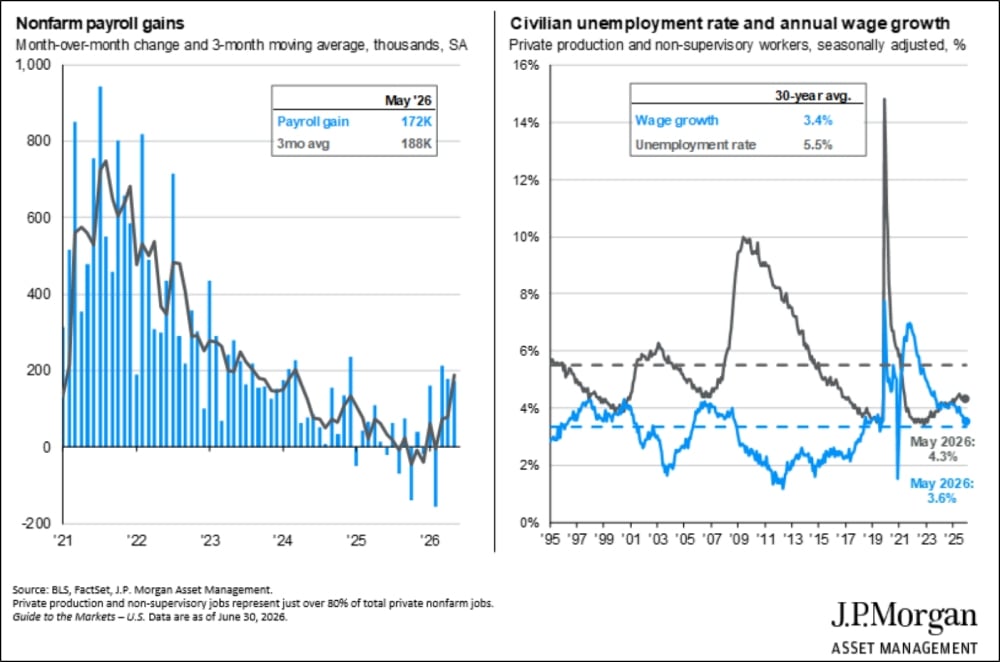
The labor market is doing fairly well, but is not growing so fast as to worsen inflationary pressures.
Concluding Comments
- Markets absorbed a major conflict, an energy shock, and a shift in Fed leadership, and still finished near record highs. We aren’t guaranteed smooth sailing ahead, but a diversified portfolio can withstand meaningful stress without requiring investors to time their way through it.
- The broadening of market returns beyond mega-cap technology is a meaningful development. Small-cap stocks gained +22% in Q2, mid-caps returned roughly +17%, and international markets kept pace. After several years of narrow leadership, the gap between the largest companies and the rest of the market has started to close on improving fundamentals.
- The AI investment cycle is real and backed by earnings, but the scale of capital being deployed approaching $900 billion in projected hyperscaler spending next year means the margin for error is narrowing. Companies are increasingly turning to debt markets to fund the buildout, and the spending will eventually need to translate into broad-based returns on invested capital to sustain current valuations.
- The new Fed chairman has signaled a more hawkish, less communicative posture than his predecessor, and inflation remains above target after five consecutive years. With the dot plot potentially being retired and rate cuts pushed out, we believe fixed income positioning should reflect a regime of higher-for-longer rates rather than an imminent easing cycle.
- Across public and private markets, the common thread is that fundamentals remain sound, even as liquidity and exit conditions in private equity stay constrained. The environment favors patience, diversification across asset classes and geographies, and a willingness to stay invested through periods where the questions outnumber the answers.
Disclosures
Past performance is not indicative of future results. Sage Mountain Advisors, LLC (“SMA”) is an independent SEC registered investment advisor. Any reference to or use of the terms “registered investment adviser” or “registered,” does not imply that SMA or any person associated with SMA has achieved a certain level of skill or training. This material is provided for informational and educational purposes only.
Any subsequent, direct communication by SMA with a prospective client shall be conducted by a representative that is either registered or qualifies for an exemption or exclusion from registration in the state where the prospective client resides. For more information pertaining to the registration status of SMA, please contact SMA or refer to the Investment Adviser Public Disclosure website (www.adviserinfo.sec.gov). The information contained herein should not be construed as personalized investment, tax, or legal advice. Certain information contained in this presentation has been derived from third party sources. While we believe these sources to be reliable, we make no representations as to the accuracy, timeliness, and completeness of any such information prepared by any unaffiliated third party incorporated herein, and take no responsibility therefore. As such, there is no guarantee that the views and opinions expressed in this presentation will come to pass.
All investments carry a certain degree of risk of loss, and there is no assurance that an investment will provide positive performance over any period of time. The statements contained herein reflect opinions, estimates and projections of SMA as of the date hereof, and are subject to change without notice. SMA reserves the right to modify its current investment strategies and techniques based on changing market dynamics or individual portfolio needs. The opinions expressed herein are those of SMA and are subject to change without notice. Information presented should not be considered as a solicitation or recommendation to buy or sell any security, financial product, or instrument discussed herein. Additionally, this material contains certain forward-looking statements which point to future possibilities. Due to known and unknown risks, other uncertainties and factors, actual results may differ materially from the results portrayed or implied in such forward-looking statements. Furthermore, the illustrative results presented in this presentation in no way reflect the performance of any SMA product or any account of any SMA client, which may vary materially from the results portrayed for various reasons, including but not limited to, investment objectives, financial situations and financial needs of SMA clients; differences in products and investment strategies offered by SMA; and other factors relevant to the management of SMA client accounts.
This presentation and its contents are provided “as is” without warranty of any kind, express or implied, including, but not limited to, implied warranties of merchantability, fitness for a particular purpose, title, non-infringement, security, or accuracy. SMA reserves the right to modify its current investment strategies and techniques based on changing market dynamics or client needs. It should not be assumed that any of the security transactions, holdings or sectors discussed were or will prove to be profitable, or that the investment recommendations or decisions we make in the future will be profitable or will equal the investment performance of the securities discussed herein.
Actual investment advisory fees incurred by clients may vary. A complete description of SMA’s fee schedule can be found in Part 2 of its FORM-ADV which is available at www.sagemountainadvisors.com or by calling (404) 795-4861. Clients are advised that no portion of the services provided by SMA should be interpreted as legal, tax or accounting advice. For legal and tax-related matters, we recommend that you seek the advice of a qualified attorney, accountant or tax professional. SMA-25-0206